

There are numerous instances where professionals have to make important decisions that affect their careers. Similarly, every individual is always making a decision before doing anything. Therefore, this is an important thing for almost everyone. When people make their choices, sometimes they think that they are dealing with pressing matters. In the real sense, some of the choices they make are not as important. Others are urgent whereas some are not. Depending on your career, there are plenty of decisions that you may need to make. As a result, you need the Eisenhower matrix mental model to help you differentiate between what’s important and what’s urgent.
According to Dwight D. Eisenhower, there are two problems linked to time management. These are knowing the important and the urgent. In this case, there are certain things that are important but not urgent. Similarly, not everything that we perceive as urgent is important. Understanding how to differentiate between the two can help one in effectively managing their time and improving their productivity.
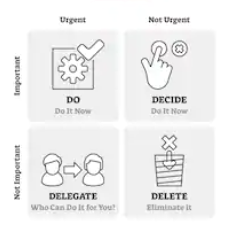
There are four quadrants on the Eisenhower matrix box. Each quadrant represents a system where you can classify tasks based on whether they are urgent or important. The matrix box provides people with a helpful system of time management. When using this framework, one would tend to question themselves about the decisions that they will be making. For instance, before prioritizing anything, the Eisenhower matrix advocates that you should ask whether a task is important or whether it’s urgent. Weighing the options will help you make the right choices on how you will handle the activities.
Important and Urgent
Activities that fall in the first quadrant are classified as “important and urgent.” Here, the model recommends that tasks in this section should be handled immediately. This quadrant brings together urgent and important tasks. As such, activities here should be handled as soon as possible.
Important but not urgent
The second quadrant of the Eisenhower matrix features the “important but not urgent” tasks. In this section, you will find tasks which might not be urgent, but in the long run, they add value to the organization or to your personal life. For instance, you can include tasks such as working out, visiting the dentist, meditation, etc. Sure, these tasks are important, but you can schedule to do them later. The point here is that there are certain tasks which should be completed. However, it is not a must that you finish them immediately. These tasks can wait for a later period. So, consider scheduling them as recommended.
Not important but urgent
The third quadrant consists of tasks classified as “not important but urgent.” Interestingly, most have plenty of these tasks in their everyday routines. You might think that these tasks are urgent, but in reality they are not relevant to your daily goals. For instance, when you are busy working using the Pomodoro technique, you might get a call from an unknown caller. Yes, it’s urgent, but it’s not as important as you think. The same goes to the idea of constantly checking your smartphone after every notification.
It is important to realize that there are certain decisions that are influenced by the urgency from other people. This means that they are not your priorities, but someone else’s priorities. As such, attending to these tasks right away only implies that you will be allowing other individuals to come in the way of your time management. Often, people find it daunting to say no. You might gain the impression that saying no will only make you look bad. The truth is that you should learn to say no respectfully.
When handling tasks which can be classified under the third quadrant, you should either avoid them or delegate. Avoiding means that you should get rid of any distractions that could prevent you from focusing. Your smartphone, for example, it’s not a must that you keep checking each and every notification that comes in. Resist the temptation by choosing to focus on your work.
Not important and not urgent
The fourth quadrant of the Eisenhower model describes tasks which are simply optional. Some of the activities that we waste our time doing are not important. They only consume our productive time. It is imperative that you monitor how you spend your time and find out whether there are tasks that fit in this quadrant. Browsing through social media pages is a good example of activities that should be classified in this category. Oftentimes, people waste their time on social media without realizing that they are wasting time.
The worst thing about spending your productive time on social media is that you never seem to realize that the clock is ticking. Instead of working on a project, you find yourself chuckling on posts from your friends. Before you know it, 30 minutes have gone and you haven’t done anything. This leaves you with a lot of pressure at the end of the day. Consequently, you will want to compensate for the lost time by working overtime.
Avoid this by learning how to classify your tasks using the Eisenhower matrix box. Working overtime only shows a clear sign that you are not managing your time effectively.